Hi 👋🏾 I’m Abhik, Ashby's Co-Founder and VP of Engineering. We’re looking for a versatile, persistent product engineer who’s not afraid to set up reusable building blocks across the stack and advocate for the time and space to do so. At Ashby, all our engineers ship features end-to-end at a high pace. Example is the best leadership. We’ll give you the room to do your best work, and you'll be our guide! If that speaks to you, read on. What Ashby gives you in return is the best of both early and growth-stage environments. The agency and no-nonsense of a seed startup: you write product specs, make product and design decisions, and build in an almost-no-meeting culture. While also the product-market fit and scale of a growth-stage startup: tens of thousands of daily users who depend on your software and eagerly await your next feature. We have notable customers like Notion, Linear, Shopify, and Snowflake. Our growth and retention metrics are best-in-class among our peers: we have tens of millions in ARR, growing >100% year over year, very low churn, and many years of runway. We’ll share more details once we meet. You’ve probably seen this role posted before, and it’s because we’re always expanding the team (we’re on track to double this year). We’re bubbling with ideas on how to support Talent Acquisition through software, and we’ve started the journey of building products beyond Talent Acquisition. We read every application and aim to respond to yours within 3-4 days (often sooner). # What We’re Building
As engineers, we are used to tooling that makes us better at what we do. When we started Ashby, we saw the opposite with Talent Acquisition software. Recruiting teams were leveling up how they did their work, but instead of software meeting this new standard, it held them back. Scheduling a final round is an excellent example. Recruiting teams wanted to schedule candidates faster, track interviewer preparation and quality, and do it with half the headcount. A recruiter needed to manually collect availability from the candidate, identify qualified interviewers, perform “Calendar Tetris” to find who is available to interview the candidate, schedule on the earliest date possible, and make any last-minute adjustments as availability changed. They must do this while considering the interview load on each individual and whether interviewers need to be trained and shadowing others. 🥵 TA software didn’t help. As hiring managers, we know TA is a critical function, and as engineers, we know software can do better. So, we built and continue to build Ashby to give TA teams the highest standard of tooling. Software that’s intelligent and powerful. Software that provides insights into where they’re failing and automates or simplifies many of the tasks they’re underwater with. We want other functions and departments to be jealous of what TA teams can do with Ashby, and today they often are! # Why You Should or Shouldn’t Apply
Software engineers come in many flavors, not all of which fit our model. Here are some things to help you decide if this fits you and what you’re looking for:
You’re not afraid to tackle any part of a technology stack. You do what’s necessary to successfully deliver a feature, whether writing frontend or choosing new infrastructure. We’ll provide a supportive environment to do it successfully (e.g., design system, SRE team). - You’ve tackled projects with a lot of product and technical ambiguity, and you thrive at the intersection of the two. We’re not building a simple CRUD app, and many of the challenges we tackle require you to use your knowledge of our customers to build powerful abstractions and flexibility in the system to solve a class of problems. - You know how to strike the right balance between speed and quality. Ashby wasn’t built quickly. We took four years to launch publicly because convincing customers to switch required a high-quality product. However, time isn’t infinite, especially for a startup, so we still move with urgency—we’ve built the equivalent of three or more VC-backed startups with a very small team. - You are ambitious and always looking to improve your skills. For most engineers, this role will give you more freedom and responsibilities than you’ve experienced in the past. To thrive (and level up), you’ll need to be open to feedback (and we give lots of it). - You’re an excellent collaborator and communicator. Ownership and freedom don’t mean you work in a vacuum. You’ll need to vet your decisions with the appropriate stakeholders, keep them up to date when necessary, and work with other engineers to get your projects across the finish line. Clear and concise communication helps a lot here! - You seek to create leverage in your work. The nature of software is that you can often automate or abstract what would be tedious, time-consuming work. Your impatience usually leads to new abstractions, tools to allow Support to debug before Engineering, new lint rules to prevent common bugs, etc. Put another way, you shouldn’t apply if:
To you, a tech lead, staff, or principal engineer is someone who spends most of their time project managing or doing architecture reviews. Our most tenured engineers spend most of their time building, and we often trust them with our most challenging problems. While they lead product and technical areas and help other engineers plan their most challenging work, it’s not a requirement, nor do engineers need their sign-off. - You need company-driven process and structure to get your projects across the finish line. Sprint planning and well-defined project management processes are things you need or look to others to lead. You’d rather focus on the technical details and challenges. - You only want to do exciting work. We’re building a team of kind, collaborative folks. Customer issues and investigations are distributed across the team, including our high-level ICs. - You can get lost in the details. Once you start implementation, it can be hard to take a step back and think about the project as a whole. You like everything to be planned upfront. - You haven’t led or taken ownership of projects before. You’re used to working with tech leads and taking on tasks distributed by them. - You want to mentor earlier-career engineers. We rely on engineers owning their projects, so we need engineers with that experience. This requires the team to be reasonably tenured. More than 90% of the team would be considered Senior or above in the industry today, so mentorship opportunities are very limited. # Engineering Culture
Our engineering culture is motivated by Benji’s (my Co-founder and CEO) and my belief that a small, talented team, given the right environment, can build high-quality software fast (and work regular hours!). We do it through:
Minimal process with ownership over decisions normally made by product and design
Natural collaboration and deliberate communication
Investing in tools and abstractions that give us leverage
Putting effort into building a diverse team
Minimal Process & Lots of Ownership
The best engineers we’ve worked with delivered reliably magical outcomes. They took customer problems and relentlessly drove them to solutions that were not only successful but often brilliant and creative. While they did this with minimal oversight, stakeholders were never in the dark as to what was going on, and no setback was a surprise. Traditional product-development processes aren’t meant for the best engineers. Their purpose is to create consistent outcomes regardless of the engineer’s skill. But, consistency comes at the expense of an engineer’s time and freedom—both ingredients necessary to generate those magical outcomes. As a result, process stifles the best engineers and doesn’t give others the opportunity to practice the behaviors that made the best engineers the “best.”
At Ashby, we want to build an environment that encourages every engineer to be their best. So, at Ashby, every Engineer runs their project. Product Managers (and Designers) build strategy, do customer research, and hand off problem briefs to Engineers. Engineers take on the rest: they research the problem, write product specs, build wireframes, and implement their solution end-to-end. We rely on engineers, not process, to push information outward to the relevant folks (e.g., Product Managers) and pull folks in to help (e.g., Designers, Infra). It’s a new level of ownership for many engineers, but we’d rather an engineer fail a bit and coach up their skills than use process as a crutch. Not everyone succeeds in our culture, but those who do thrive. ## Collaboration is Natural & Communication is Deliberate
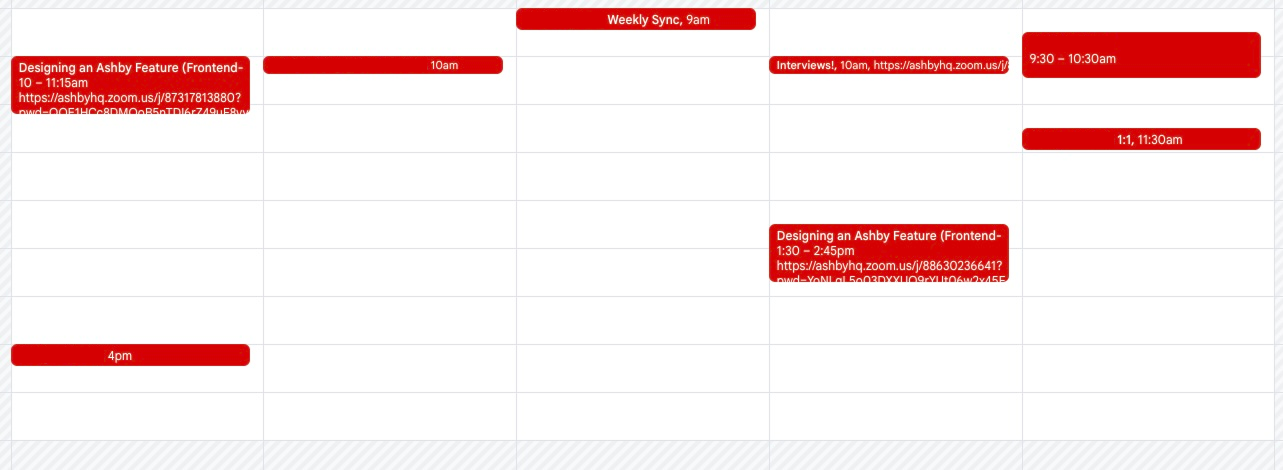
Our engineering team consists of lifelong learners who are talented but also humble and kind (meet them here!). These attributes create an environment where collaboration happens naturally. We combine this with research, prototyping, and written proposals to see around corners and get feedback from the team across time zones. Focus time is something that we hold sacred, and, with thoughtful and deliberate communication, engineers are in <2h meetings per week (I wrote about it here). To drive it home, here's a recent calendar of an engineer who has been with us for over 4 years. ~34 hours of focus time, 2.5h of interviews, and 3.5 hours of meetings:
We also meet in person at least twice a year, once as a department and once as a company. You also have a small budget to meet up with folks in your city/region. ## Increase Leverage, not Team Size
We built Ashby with the quality, breadth, and depth that many customers would expect from much larger teams over larger time scales. We’ve done this through investment in:
Great developer tooling. Our CI/CD takes ~10m, and we deploy at least 15x a day. A debugger that works out of the box. Everyone on the team has contributed to our developer experience 💪🏾. - Building blocks to create powerful and customizable products fast. At the core of Ashby is a set of common components (analytics modeling and query language, policy engine, workflow engine, design system) that we constantly improve. Each improvement to a common component cascades throughout our app (short video below). - AI-powered tooling. We think of AI as a way to automate the mundane parts of building and maintaining high-quality software. We use a combination of third-party and internally built tools that, for instance, auto-triage customer issues, suggest fixes, prototype ideas, generate production-ready code, and conduct code reviews. Engineers have an unlimited token budget (but are not measured on it). Here’s an impromptu quote from Arjun in our company Slack of what it’s like to build a feature at Ashby:
And a demo of one of these building blocks:
Interview Process
At Ashby, our team and interview process want to help you show your best self. We’ll dive into past projects and simulate working together via pair programming, writing product and tech specs collaboratively, and talking through decisions. There are no leetcode or whiteboard exercises. Our interview process is three rounds:
Introduction call with Hiring Manager (15 to 30m, live)
A technical screen where we pair in our actual codebase (1h, live)
Three non-coding interviews that focus on product thinking, technical design, and infrastructure (3h 15m, live can be split across multiple days)
Depending on our leadership team’s bandwidth, we may start with an additional 30m screen with a recruiter. Your hiring manager will be your main point of contact and prep you for interviews. Each round will have written guidance so you know what to expect (you’ll need minimal preparation). You’ll meet 4 to 6 people in engineering (with 5-15 minutes in each interview to ask them questions). If we don’t give an offer, we’ll provide feedback! # Your First Three Months at Ashby
We want an exceptional onboarding experience for every new hire. At Ashby, your dev environment is set up with a single script, you push your first product change on day one, and you spend the rest of your time shipping product changes that give you a tour of our codebase and best practices. The product changes increase in scope and ambiguity from simple copy changes to the delivery of a prominent, impactful feature. Your manager will do a 30, 60, and 90-day review to give feedback and calibrate on how we work together. It’s a team effort to get you successfully onboarded; you’ll have a peer paired with you to answer questions, pair program, and check in often to see if you need help. The rest of the team will run training sessions on our culture, product, engineering process, and technical architecture. # Technology Stack
I’m sharing our tech stack with the caveat that we don’t require previous experience in it (but a love of typed languages is helpful 😀): TypeScript (frontend & backend), React, GraphQL API, Node.js, Postgres, Redis. When they joined Ashby, many of our engineers switched from other languages like Swift and Kotlin (Ben), platforms like iOS (Tom) and Windows (Sergey). We care more about fundamentals (e.g., debugging, abstractions) and how fast you learn. For folks on the team who switched, it's nice seeing changes hot reload versus waiting for XCode to compile 😅. # Benefits
Competitive salary and equity. - 10-year exercise window for stock options. You shouldn’t feel pressure to purchase stock options if you leave Ashby —do it when you feel financially comfortable. - Unlimited PTO, and we will encourage you to take it. - A minimum of 12 weeks of fully paid parental leave, covered by Ashby. For folks outside the US, it may be longer to be in line with regional requirements. - Generous equipment, software, and office furniture budget. Get what you need to be happy and productive! - $100/month education budget with more expensive items (like conferences) covered with manager approval. - If you’re in the US, we offer top-tier health insurance for you and your dependents, with 100% of premiums covered by Ashby. In other countries, we provide high-quality supplemental health insurance for you and your dependents, also fully covered by us. Ashby’s success hinges on hiring great people and creating an environment where we can be happy, feel challenged, and do our best work. We’re being deliberate about building that environment from the ground up. I hope that excites you enough to apply. Ashby provides equal employment opportunities (EEO) to all employees and applicants for employment without regard to race, color, religion, sex, national origin, age, disability, genetics, sexual orientation, gender identity, or gender expression. We are committed to a diverse and inclusive workforce and welcome people from all backgrounds, experiences, perspectives, and abilities.
Ashby is committed to a fair and transparent hiring process. We confirm that this advertisement is for an active, existing vacancy within our organization. Please be advised that we may use artificial intelligence-driven tools to assist our recruitment team in screening, assessing, and selecting candidates for this position.